The Genre-Bending Genius of Herbie Hancock
By Staff | Published on N/A
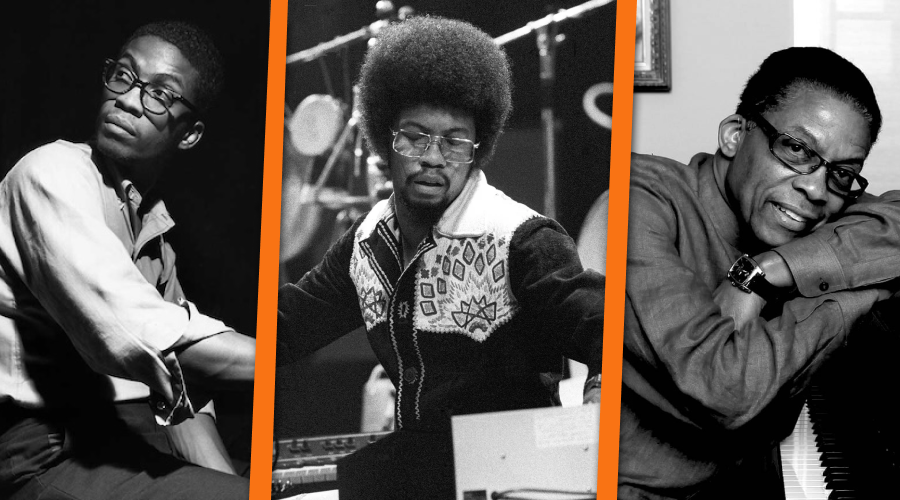
An examination of Herbie Hancock's career is to analyze the trajectory of Jazz over the past sixty years. From his foundational contributions to Post-Bop in the 1960s to his pioneering work in Jazz Fusion in the 1970s and beyond, Hancock has functioned as a primary innovator, consistently reshaping the musical landscapes he has inhabited. His discography reveals a central operating principle: a dynamic tension between sophisticated harmonic structures and expansive improvisation. Hancock is a principal architect of modern jazz harmony, creating complex frameworks that simultaneously serve as platforms for profound improvisational exploration.
Stage 1: The Blue Note Period & Post-Bop Architect (1962-1968)
Hancock's initial recordings for Blue Note Records are rooted in the hard-bop idiom, yet they exhibit a forward-thinking creative impulse. Compositions such as "Watermelon Man" from his 1962 debut, Takin' Off, and "Cantaloupe Island" from Empyrean Isles (1964), utilize funk-inflected grooves that provided an accessible structure, leading to their commercial success. Within these frameworks, however, Hancock's pianism is characterized by its crisp articulation and advanced harmonic vocabulary. He was already manipulating standard forms, testing their boundaries while respecting their traditions. This period culminated in the 1965 album "Maiden Voyage", a work defined by its use of suspended harmonies and modal concepts to create a unique sense of atmospheric ambiguity and open-ended exploration.
Stage 2: The Second Great Quintet & The Electric Frontier (1963-1968)
His tenure with the second great Miles Davis Quintet was a period of intense experimentation that reshaped his artistic direction. In this ensemble, Hancock further developed his ability to deconstruct and re-contextualize rhythm and harmony. The quintet's methodology prioritized real-time interaction, with an emphasis on spontaneous reaction over adherence to pre-composed structures. This evolution is audible on albums like Filles de Kilimanjaro (1968), a pivotal recording where Hancock's adoption of the electric piano marks a clear transition from acoustic post-bop toward the electric instrumentation that would define the next era of jazz.
Stage 3: The Mwandishi Experiments & The Jazz-Funk Revolution (1971-1975)
Before the commercial breakthrough of The Headhunters, Hancock led the Mwandishi sextet through a series of deeply experimental albums, including Mwandishi (1971), Crossings (1972), and culminating in the seminal 1973 album Sextant. This work was a radical fusion of avant-garde jazz, funk, and African rhythms, all filtered through a dense tapestry of electronic textures. Utilizing an array of synthesizers, Sextant created otherworldly soundscapes that were abstract and challenging. Its forward-thinking use of electronics and atmospheric composition is now seen as a clear antecedent to modern genres like ambient, techno, and IDM, profoundly influencing generations of electronic producers.
This deconstructive ethos led directly to the formation of The Headhunters. The release of Head Hunters in 1973 was a watershed moment, grounding his experimental tendencies in irresistible grooves. On tracks like "Chameleon," Hancock fully embraced electronic textures, utilizing synthesizers like the ARP Odyssey and the Hohner D6 Clavinet to create deep, polyrhythmic funk. The raw, improvisational energy of this new direction was documented on the 1975 live album Flood, which demonstrates how concise studio arrangements were expanded in a live context into sprawling, high-energy improvisations.
Stage 4: V.S.O.P. and The Dual Career (Late 1970s - 1980s)
Despite the immense success of his electric music, demand for Hancock's acoustic pianism remained high. This led to the 1976 formation of the V.S.O.P. Quintet, a reunion of the 1960s Miles Davis Quintet with Freddie Hubbard on trumpet. Intended as a one-time concert, the group's reception was so overwhelmingly positive that it launched years of extensive touring. An anecdote from this era notes that Hancock would often perform two distinct concerts in a single night: one set with the acoustic V.S.O.P. Quintet, followed by another with his contemporary electric funk band. This unique touring schedule solidified his status as a master of two musical worlds, equally at home in both acoustic and electric settings.
A Career of Collaboration (1960s-Present)
Hancock's extensive work as a collaborator demonstrates his profound influence and adaptability. Beyond his foundational work with Donald Byrd, his contributions span the entire musical spectrum. His celebrated duo albums and tours with pianist Chick Corea are masterclasses in improvisational dialogue. His work with bassist Jaco Pastorius on "Come On, Come Over" is a dynamic display of high-energy funk. In the 1980s, his collaboration with producer Bill Laswell on the album Future Shock produced the groundbreaking track "Rockit," which fused jazz with electro-funk and nascent hip-hop, cementing his influence on yet another generation of artists.
Conclusion
An overview of Herbie Hancock's discography confirms that musical evolution is a process of synthesis and re-imagination rather than a repudiation of the past. His career exemplifies the notion that formal structure and improvisational freedom are not contradictory, but symbiotic elements. By mastering this duality, Herbie Hancock has produced a body of work of immense intellectual and visceral power, securing his position as one of the most consequential musicians in modern history.
Listen the full breadth of his genius in our chronological playlist below: