The Bureaucrat and the Partisan Wall: Twenty Years of Tim Hecker's Harmony in Ultraviolet
Before quitting his desk job as a policy analyst for the Canadian government, Tim Hecker used a snapshot from Bologna and a Matisse pun to shatter the rules of ambient music.
By Linernotd Ambient / New Age | Published on October 16, 2026
For decades, ambient music operated under the polite rules Brian Eno established in 1978: it was meant to be functional, unobtrusive, and "as ignorable as it is interesting." In 2005, the person quietly preparing to blow up that definition was sitting in a government office in Ottawa. By day, Tim Hecker worked a nine-to-five job as a political risk and policy analyst for the Canadian federal government. In his off-hours between Ottawa, Montreal, and a brief residency at the Banff Centre for the Arts in Alberta, he was assembling his fourth album, Harmony in Ultraviolet.
Rather than building soft synthesizer beds for relaxation, Hecker approached the sessions like a demolition crew. He took recordings of pipe organs, pianos, and electric guitars, feeding them through guitar pedals, digital bit-crushers, and heavy amplifier distortion until the original instruments were buried under sheets of white noise. He sequenced the fifteen tracks into a continuous structural loop, opening the album with "Rainbow Blood" and closing it with its twin, "Blood Rainbow." It was ambient music engineered to be played at the physical, chest-rattling volume of a My Bloody Valentine gig.
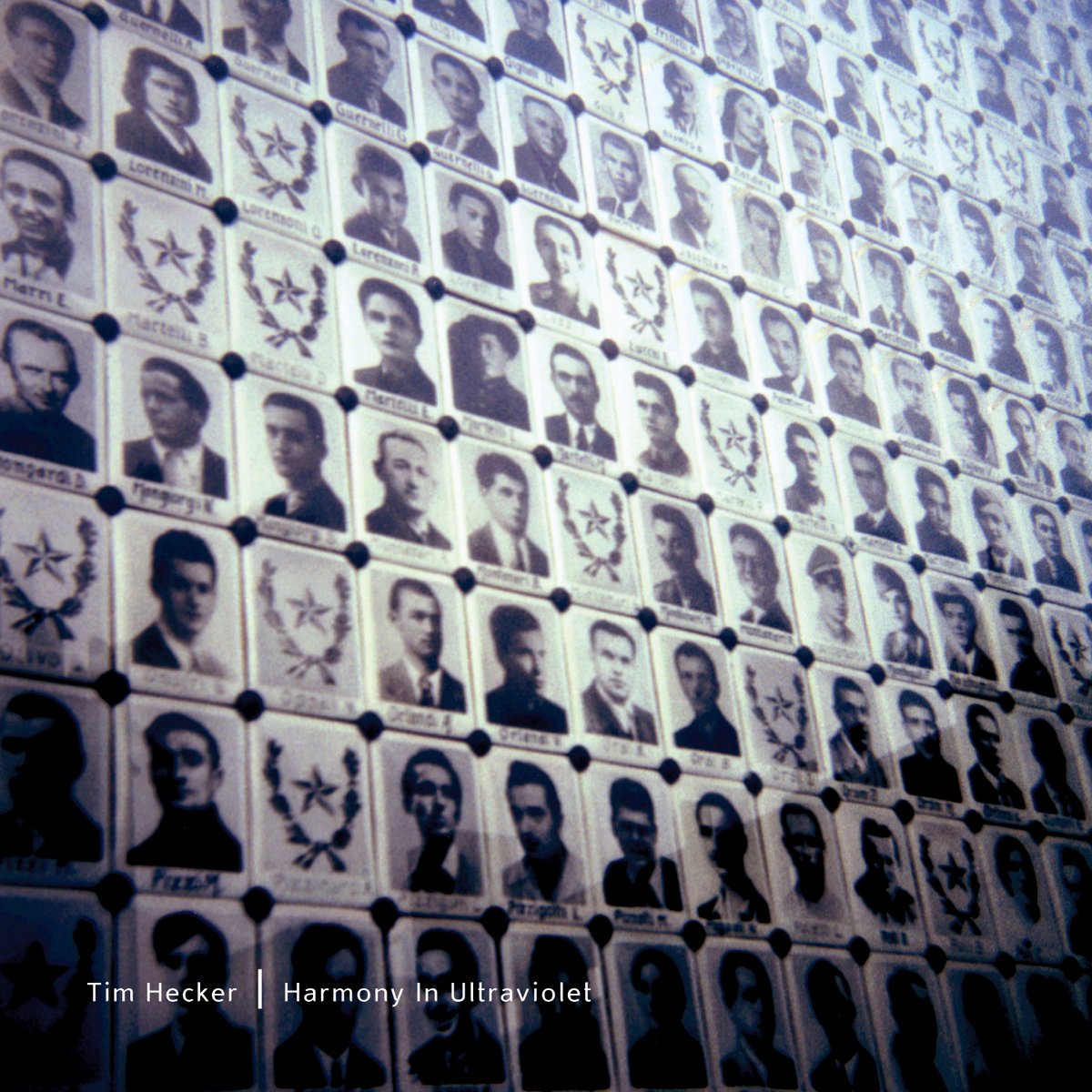
The visual identity of the record relied on the same mix of high art and harsh reality. Hecker adapted the title from Henri Matisse's 1908 fauvist painting Harmony in Red, swapping the warm primary color for an invisible, high-frequency spectrum of light known primarily for burning skin. For the cover of his Kranky label debut, he bypassed abstract digital graphic design entirely. The sleeve is a photograph of the Sacrario dei Partigiani in Bologna's Piazza Maggiore, a sprawling outdoor stone wall holding roughly two thousand small, weathered photographs of Italian Resistance fighters killed by fascists during World War II. Viewed from a sharp angle on the cover, the rows of solemn human faces blur into what looks like a cold rack of studio electronics.
Shortly after finishing the album in 2006, Hecker finally handed in his resignation to the Canadian government, relocated full-time to Montreal, and enrolled in a PhD program at McGill University to write a dissertation on the history of ear-shattering acoustics. When Harmony in Ultraviolet hit shelves on October 16, 2006, it permanently rewired experimental music. Twenty years on, the masterpiece that turned ambient music into a blood-sport of sheer volume remains the parting gift of a civil servant clocking out for good.
You can revisit the full 50-minute loop from "Rainbow Blood" to "Blood Rainbow" via this Tim Hecker Harmony in Ultraviolet full album stream, which also displays the Bologna partisan memorial artwork featured on the original 2006 Kranky sleeve.